Real Estate & Rentals
Free Sublease Agreement Template (PDF)
A sublease agreement is a contract in which a tenant rents all or part of their home to someone else, the subtenant, for part of the lease term. The original tenant stays responsible to the landlord, and the subtenant agrees to follow the original lease.
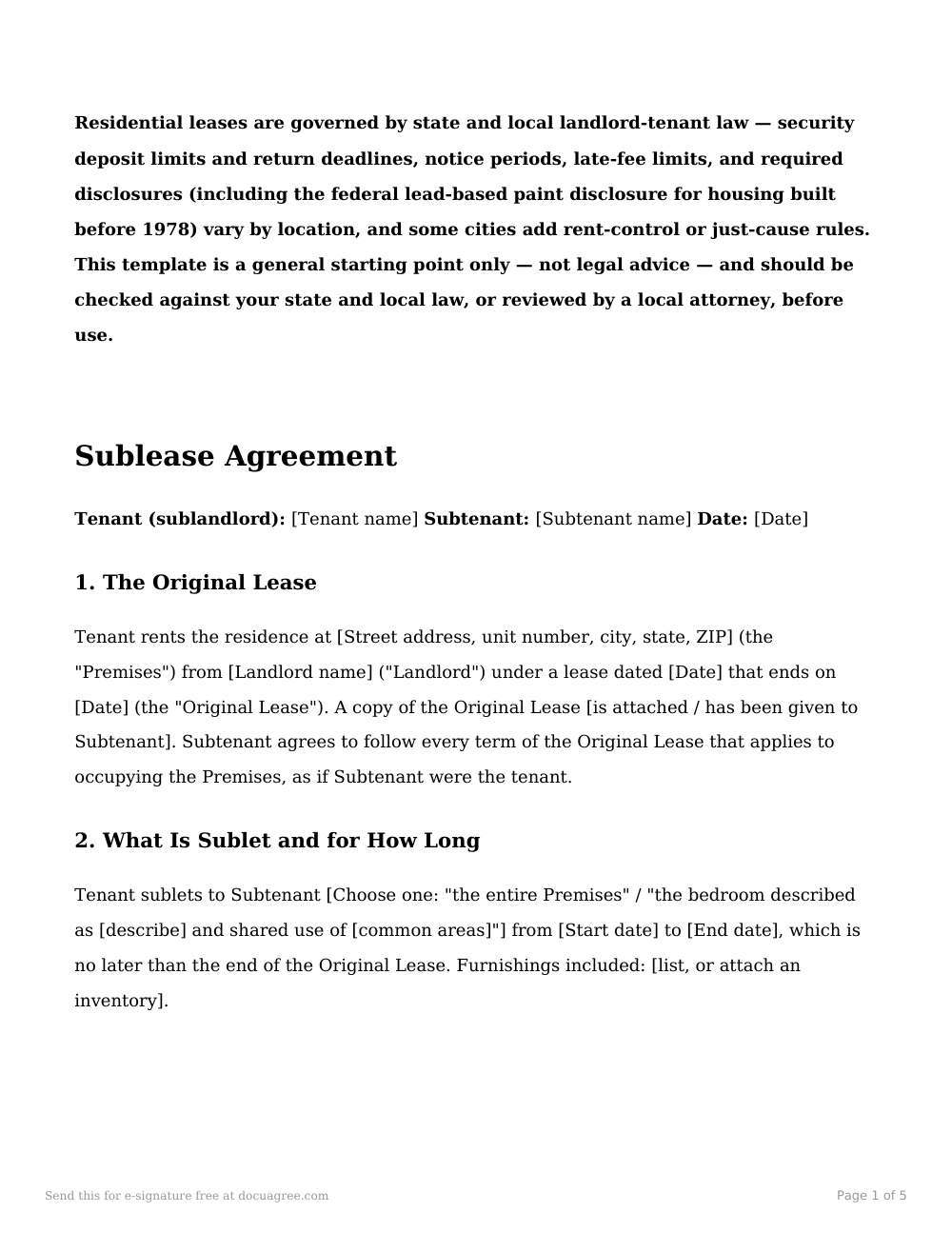
Download the template
Free, no signup required. Fill in the blanks by hand, or use it below to fill and send for signature.
When to use it
Use a sublease when you need to leave for a while but want to keep your lease, for example for a summer internship, travel, or a temporary job, or when you're renting a spare room to someone not on the lease. Most leases require the landlord's written consent to sublet, so this template includes the landlord as a third signer who consents in the same document.
What's typically included
- The original lease and the subtenant's duty to follow it
- Whether the whole home or one room is sublet, and the dates
- Furnishings included
- Rent, due date, and who it's paid to
- Security deposit and its return
- Utilities
- Move-in condition and move-out
- The original tenant's ongoing responsibilities
- What happens if the original lease ends early
- No further subletting by the subtenant
- Entire agreement and governing law
- Landlord's consent, with no release of the original tenant
- Signature blocks for tenant, subtenant, and landlord
How to fill it in
- Read your own lease first. Most require the landlord's written consent to sublet, and subletting without it can be grounds for eviction. If yours doesn't require consent, you can remove the landlord as a signer and delete Section 11.
- Give the subtenant a copy of your lease, or attach it, since they're agreeing to follow its terms.
- Make the sublease end no later than your own lease, and check your city's rules if you plan to charge more than your own rent: some cities limit that.
- Do a move-in walkthrough with photos and attach the checklist. You're responsible to the landlord for damage, so you need evidence of the condition when the subtenant moved in.
Residential leases are governed by state and local landlord-tenant law — security deposit limits and return deadlines, notice periods, late-fee limits, and required disclosures (including the federal lead-based paint disclosure for housing built before 1978) vary by location, and some cities add rent-control or just-cause rules. This template is a general starting point only — not legal advice — and should be checked against your state and local law, or reviewed by a local attorney, before use.
Frequently asked questions
Do I need my landlord's permission to sublease?
Usually. Most leases require the landlord's written consent, and some states and cities give tenants a right to sublet that the landlord can't unreasonably refuse. Check your lease and local law. This template includes the landlord as a signer so the consent is in the same document.
Who is responsible if the subtenant doesn't pay or damages the place?
You are, as the original tenant. A sublease doesn't release you from your lease, so the landlord can still hold you responsible for the full rent and any damage. You can then recover the amount from the subtenant under the sublease.
What's the difference between a sublease and a lease assignment?
In a sublease, you keep your lease and rent to the subtenant for part of the term, usually planning to come back. In an assignment, you transfer the whole remaining lease to someone else and step out. This template is for a sublease.
Can all three parties sign a sublease electronically?
Yes. The tenant, subtenant, and landlord each get their own link and sign on any device. Under the U.S. ESIGN Act and state UETA laws, the e-signed sublease and the landlord's consent are as valid as paper signatures.
Ready to use this template?
Every word is editable before you send — this is a starting point, not a final draft.