Real Estate & Rentals
Free Lease Termination Agreement Template (PDF)
A lease termination agreement is a contract in which a landlord and tenant both agree to end a lease before its scheduled end date. It sets the move-out date, final rent, any early termination fee, how the security deposit is handled, and releases both sides from the lease after that date.
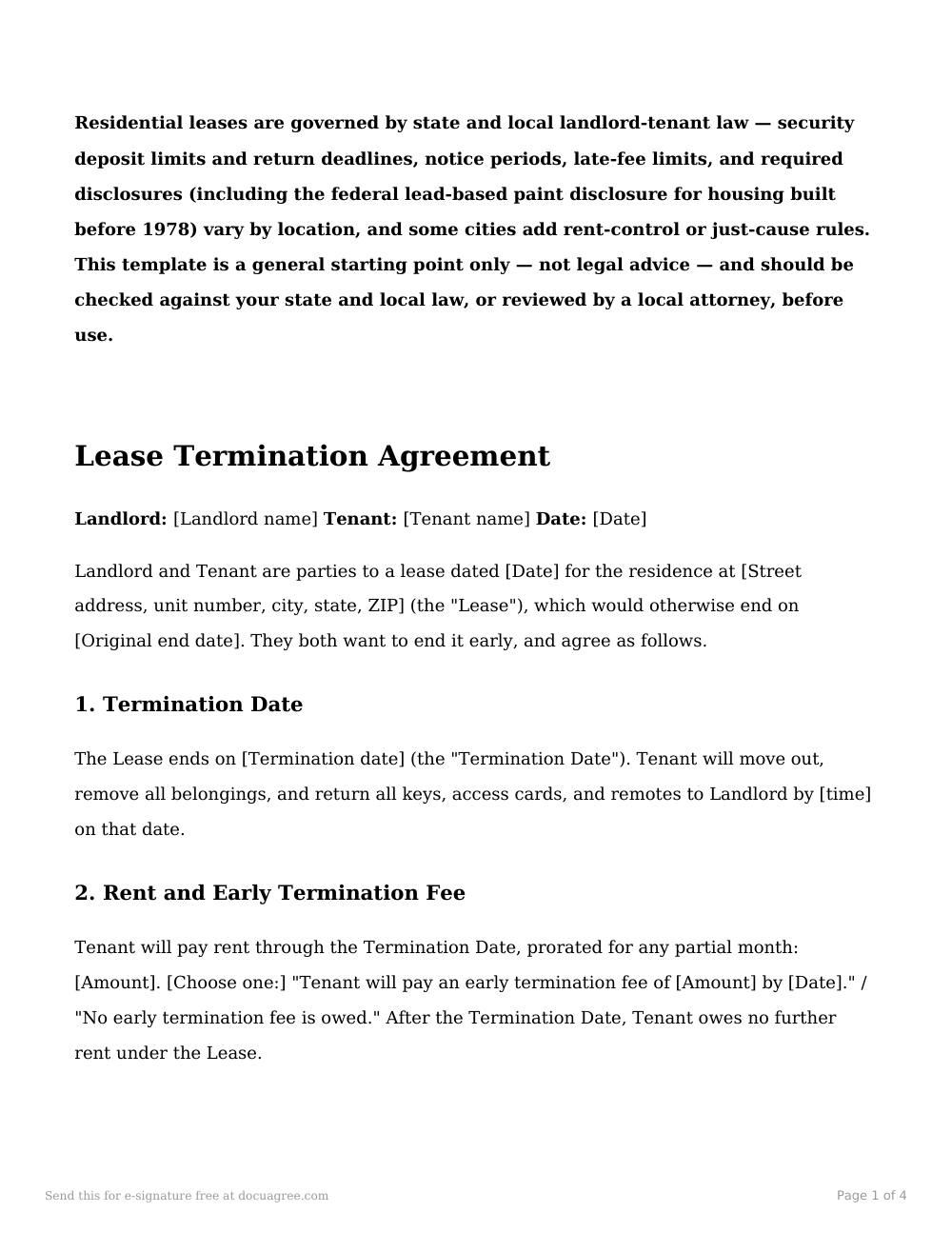
Download the template
Free, no signup required. Fill in the blanks by hand, or use it below to fill and send for signature.
When to use it
Use it when a tenant needs to leave early (a job move, buying a home, a change in family) and the landlord agrees, or when the landlord wants the unit back and the tenant agrees to leave. Putting it in writing protects the tenant from being charged rent for the rest of the term and protects the landlord from a tenant who changes their mind. It is a mutual agreement, not an eviction notice: a landlord ending a tenancy without the tenant's agreement has to follow the notice rules in state law.
What's typically included
- The lease being ended and its original end date
- Termination date and key return
- Final rent through the termination date
- Early termination fee, or none
- Condition of the premises and move-out inspection
- Security deposit return with itemized deductions
- Mutual release from future obligations, with clear exceptions
- What happens if the tenant doesn't move out on time
- Entire agreement and governing law
- Signature blocks for landlord and tenant
How to fill it in
- Agree on the termination date and any fee before you send it. A fee of one or two months' rent is common, but it's a negotiation, not a rule. Some states also let a landlord charge only actual losses, so check yours.
- Use your state's deadline for returning the security deposit, and send an itemized list of any deductions.
- Pick one option in Section 6 for a tenant who doesn't leave on time. Either way, a landlord can only regain possession through the court process: no lockouts.
- Every tenant on the lease should sign, so no one remains bound to it.
Residential leases are governed by state and local landlord-tenant law — security deposit limits and return deadlines, notice periods, late-fee limits, and required disclosures (including the federal lead-based paint disclosure for housing built before 1978) vary by location, and some cities add rent-control or just-cause rules. This template is a general starting point only — not legal advice — and should be checked against your state and local law, or reviewed by a local attorney, before use.
Frequently asked questions
Can a landlord use this to end a lease?
Only if the tenant agrees and signs. Without the tenant's agreement, a landlord has to give the notice state law requires and, if the tenant doesn't leave, go through the court eviction process. Those notices often have to be delivered in a specific way, such as in person or by certified mail.
How much is a typical early termination fee?
One to two months' rent is common, but it's whatever the landlord and tenant agree. Some leases set the fee in advance, and some states limit a landlord to their actual losses, such as rent until a new tenant moves in.
Do I still get my security deposit back?
Yes, minus lawful deductions for unpaid rent and damage beyond normal wear and tear, within your state's deadline. The agreement can also say the early termination fee comes out of the deposit.
Can a lease termination agreement be signed electronically?
Yes. Under the U.S. ESIGN Act and state UETA laws, both parties can e-sign it and it's as binding as paper. Because it's a mutual agreement rather than a legal notice, the delivery rules for eviction notices don't apply to it.
Ready to use this template?
Every word is editable before you send — this is a starting point, not a final draft.