Service Agreements & Contracts
Free Home Improvement Contract Template (PDF)
A home improvement contract is the agreement between a contractor and a homeowner for remodeling, repair, or construction work on a home. It sets the scope of work, materials, schedule, price and payment milestones, permits, change orders, lien waivers, warranty, and the homeowner's right to cancel.
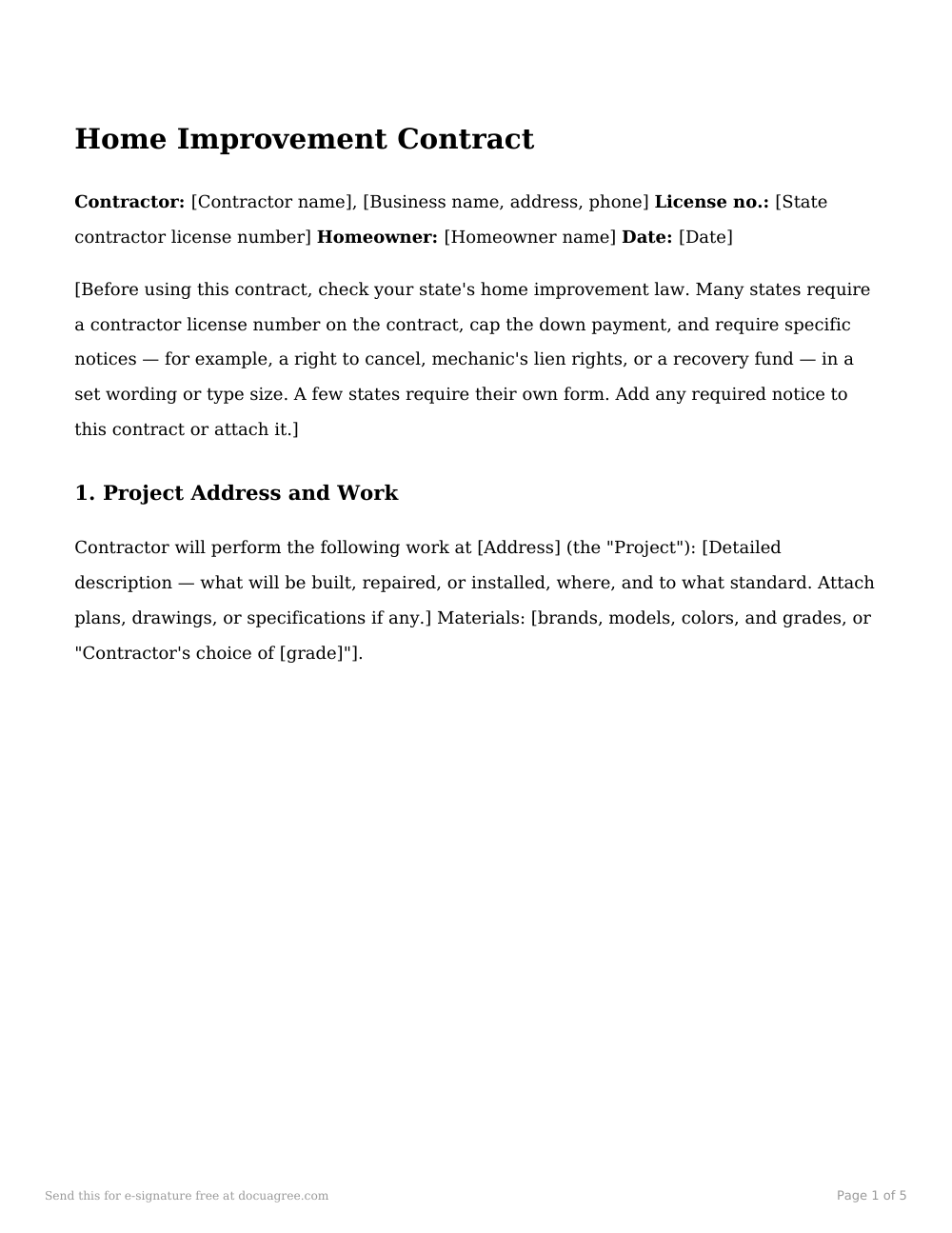
Download the template
Free, no signup required. Fill in the blanks by hand, or use it below to fill and send for signature.
When to use it
Use it for any residential project, such as a kitchen or bathroom remodel, a deck, roofing, flooring, or an addition. Home improvement is one of the most regulated small-business contracts: many states require a license number, specific notices, and a cap on the deposit in the contract itself. This template includes the core terms and prompts you to add your state's required notices.
What's typically included
- Contractor details and license number
- A prompt to check your state's home improvement law
- Detailed scope of work and materials
- Start and completion dates, and allowed delays
- Total price and milestone payment schedule
- Deposit with a state-cap reminder
- Permits and building codes
- Written change orders
- Hidden conditions (rot, mold, code issues)
- Site access and cleanup
- Subcontractors and lien waivers
- Insurance certificates
- Workmanship warranty
- Right to cancel for in-home sales
- Disputes and governing law
- Signature blocks for contractor and homeowner
How to fill it in
- Look up your state's home improvement contract rules before you use this. Many require the license number, a maximum deposit, a notice of the right to cancel, and mechanic's lien notices; a few, like California, prescribe detailed wording.
- Describe the work in detail and attach drawings or specifications. A vague scope is the most common cause of disputes and unpaid invoices.
- Tie payments to completed milestones, not to dates, so payments never get ahead of the work.
- If you signed with the homeowner at their home, give them a separate three-day cancellation notice under the FTC Cooling-Off Rule and any state equivalent.
This template is a general starting point, not legal advice — customize it and have it reviewed for your situation.
Frequently asked questions
What should a home improvement contract include?
At minimum: the contractor's license number, a detailed description of the work and materials, start and completion dates, the total price and payment schedule, how changes are handled, warranty terms, and any notices your state requires, such as the right to cancel and lien rights.
How much can a contractor charge as a deposit?
It depends on the state. Several states cap home improvement deposits, for example at 10% of the price or a fixed dollar amount, and some limit any payment that gets ahead of the work. Check your state's rule before filling in the deposit.
What is a lien waiver and why does a homeowner need one?
If a contractor doesn't pay its subcontractors or suppliers, they may be able to place a lien on the home. A lien waiver is their written confirmation that they've been paid and give up that right. Collecting them before the final payment protects the homeowner.
Can a home improvement contract be signed electronically?
Generally yes: under the U.S. ESIGN Act and state UETA laws, e-signatures are valid for contracts like this. Some state notices, such as the right-to-cancel form, have specific delivery rules, so check your state's requirements.
Ready to use this template?
Every word is editable before you send — this is a starting point, not a final draft.